


Ace in BlackJack
How Much Is an Ace Worth in Blackjack? Rules and Strategy
The ace is worth either 1 or 11 in blackjack, but that short answer hides the card’s real importance. Its value changes with the rest of the hand, allowing the same cards to move from a flexible soft total to a fixed hard total as play continues. Understanding that switch helps players read their hands correctly, avoid unnecessary stands and recognise useful doubling or splitting opportunities. This guide explains how blackjack ace values are calculated, what happens when several aces appear, how a natural blackjack differs from any other 21 and how the dealer’s ace affects the round.
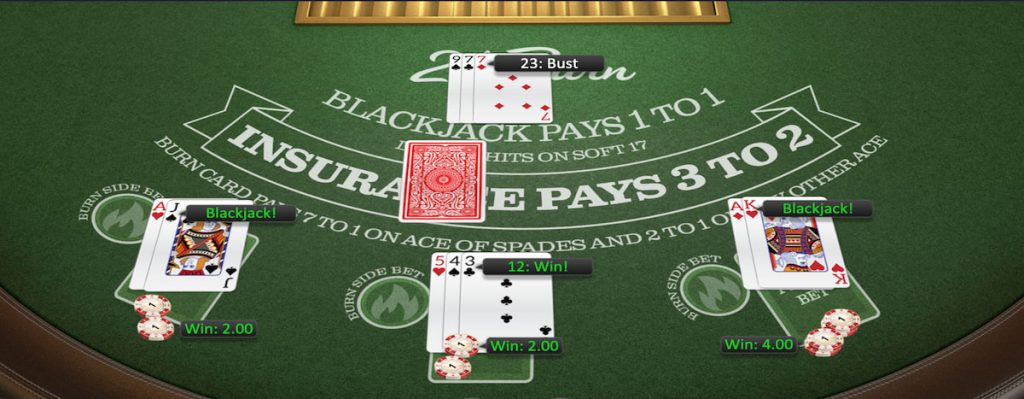
Blackjack Ace Value: The Quick Answer
An ace counts as 11 whenever that produces the highest total of 21 or less. If using 11 would take the hand over 21, the ace counts as 1 instead. The conversion is automatic: players do not need to declare a value when the card arrives. They decide whether to hit, stand, double or split, while the hand is scored at its best available non-busting total.
| Hand | Ace Value | Best Total | Hand Type |
|---|---|---|---|
| A + 5 | 11 | 16 | Soft 16 |
| A + 5 + 10 | 1 | 16 | Hard 16 |
| A + K | 11 | 21 | Natural blackjack |
| A + 7 + 3 | 11 | 21 | Three-card 21 |
How Does an Ace Work in Blackjack?
The game always evaluates an ace in the most favourable way that does not bust the hand. Take A-6 as an example. It can be read as 7 or 17, but its active total is soft 17 because 17 is the higher playable result. If a 10 is drawn, counting the ace as 11 would produce 27, so it drops to 1 and the hand remains alive as hard 17.
This is sometimes described as “choosing” whether an ace is 1 or 11, but that wording can confuse beginners. You choose the next action, not the card’s official value. If you stand on A-6, the hand is settled as 17. If you hit it and receive a large card, the calculation adjusts immediately. The same system applies to the dealer.
What Happens When a Hand Contains Multiple Aces?
Multiple aces are counted one at a time. At most one ace can be worth 11 in a playable hand; two aces valued at 11 would already contribute 22. The remaining aces therefore count as 1. If even one 11-point ace would make the total exceed 21, all aces count as 1.
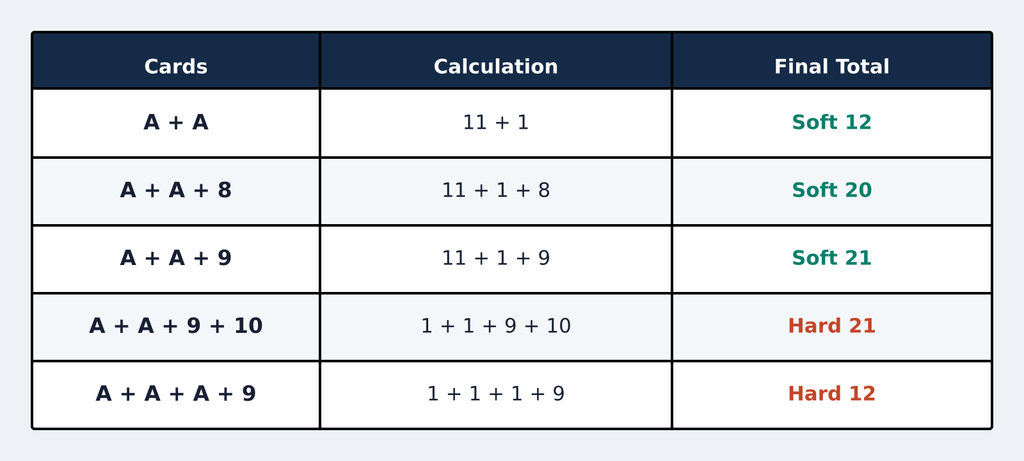
A quick mental method is to count every ace as 1 first. Add 10 to the total if doing so keeps the hand at 21 or below. For A-A-7, begin with 1 + 1 + 7 = 9, then add 10 to reach soft 19. This shortcut works regardless of how many cards are in the hand.
Soft Hands vs Hard Hands
A soft hand contains an ace currently counted as 11. It has a safety cushion because one high draw can convert that ace to 1 instead of causing an immediate bust. A hard hand either has no ace or contains only aces that must count as 1.
The difference matters even when two hands display the same total. A-5 is soft 16 and cannot bust with a one-card hit. In contrast, 10-6 is hard 16 and will bust if the next card is 6 or higher. Treating those hands identically removes the main strategic advantage created by the ace.
A soft hand can become hard after a draw. For example, A-7 is soft 18, but A-7-8 is hard 16 because the ace must fall to 1. Once no ace can remain at 11, the extra protection disappears and hard-total strategy applies.
When Does an Ace Make a Natural Blackjack?
A natural blackjack is specifically an ace and a 10-value card (a 10, jack, queen, or king) dealt as your first two cards. It outranks an ordinary 21 made with three or more cards. If both the player and dealer have a natural blackjack, the usual result is a push and the original stake is returned.
Do not assume that every two-card 21 receives a blackjack payout. An ace and king produced after splitting aces is normally treated as a regular 21, not a natural. Standard wins commonly pay 1:1, while a natural may pay 3:2 or a less favourable rate such as 6:5. The displayed game rules determine the exact return, so the payout should be checked before placing a bet.
How to Play Soft Ace Hands
Soft hands are often played more actively than equal hard totals. Hitting carries less immediate risk, while doubling can be attractive when the dealer has a weak upcard. The table below is a practical starting point for a common multi-deck game in which the dealer stands on soft 17. It is not a universal chart: deck count, dealer procedure and doubling restrictions can change individual decisions.
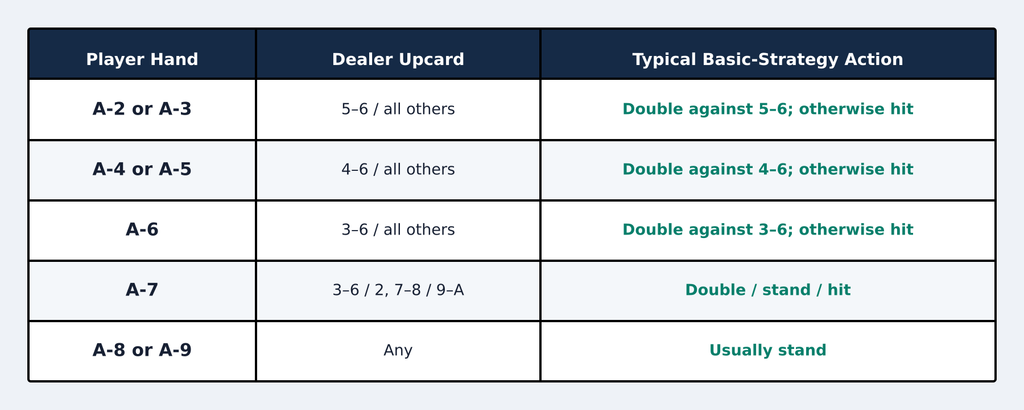
If doubling is not available, the fallback is generally to hit the lower soft totals and stand on the stronger ones, according to the matching chart. Soft 18 deserves particular attention: it is not an automatic stand. Against a dealer 9, 10 or ace, hitting is commonly the stronger play, while weak dealer cards can create a doubling opportunity.
Why Basic Strategy Usually Says to Split Aces
A pair of aces is worth only soft 12 when kept together. That is an awkward starting hand: it is too low to stand confidently and cannot be doubled into one of the standard strong two-card totals. Splitting changes it into two hands, each beginning with an ace. A 10-value card can then create 21 on either hand, while cards from 8 through 10 produce strong totals of 19 through 21.
Splitting requires a second stake equal to the original bet, so you create two separate hands and settle them independently. Many tables limit each split ace to one additional card. They may also prohibit hitting, doubling or resplitting aces. Even with those restrictions, splitting aces remains the normal basic-strategy decision in standard blackjack.
Always check how the game treats a 21 made after the split. In most games, A-10 on a split hand pays as a regular win rather than as a natural blackjack. Certain no-hole-card formats also increase your risk because you can lose extra split stakes if the dealer later reveals a blackjack. A strategy chart matched to the exact game handles these less common exceptions.
Why Players Also Split Eights
The familiar advice to “split aces and eights” groups two very different problems. Players split aces to create two high-potential starts and split eights to escape hard 16, one of blackjack’s weakest totals. Keeping two eights leaves the player with 16; splitting produces two hands that begin at 8 and gives each a chance to improve. The shared recommendation is memorable, but the reasoning is not the same.
What Changes When the Dealer Shows an Ace?
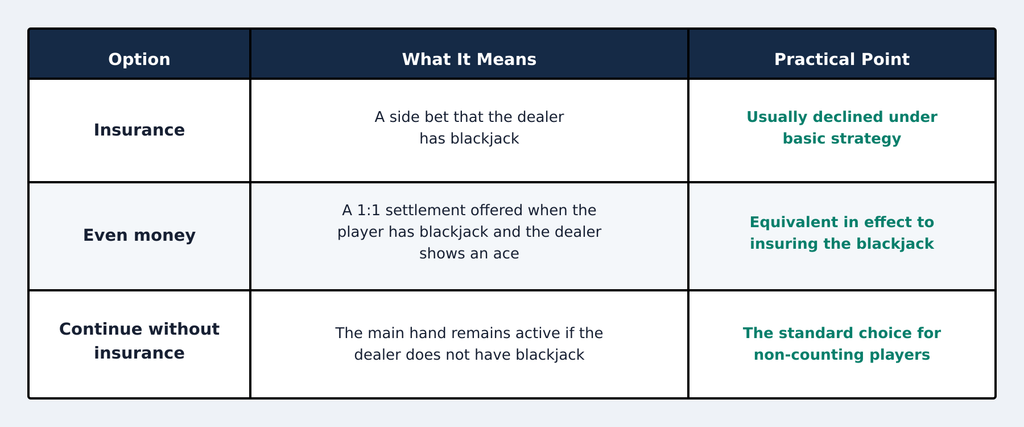
A dealer ace is a strong upcard because any hidden 10-value card completes blackjack. In games with a hole card, the dealer will normally check for blackjack before ordinary player decisions continue. If no blackjack is present, the round proceeds under the table’s standard rules.
Casinos may also offer insurance at this point. Insurance is a separate wager, usually up to half the main stake, that pays 2:1 if the dealer’s hidden card completes blackjack. This option does not offer genuine protection for the player’s hand; it serves as an additional bet on one specific outcome. Without information showing an unusually high concentration of 10-value cards, basic strategy generally declines it.
How the Dealer Plays an Ace
The ace has the same flexible value for the dealer, but the dealer does not make strategic choices. House procedure requires draws up to a specified total. The important variation is soft 17, such as A-6. At an S17 table, the dealer stands; at an H17 table, the dealer must take another card. Game information or the felt normally displays this instruction.
This distinction can also alter a few player decisions involving soft hands. A generic strategy chart is useful for learning patterns, but the most accurate play comes from matching the chart to the number of decks, the soft-17 rule and the available double and split options.
Common Mistakes With Aces in Blackjack
- Stopping on every soft total: A soft 15 or 16 may look safe, but standing usually leaves a weak final hand.
- Playing soft 18 like hard 18: A-7 can call for a hit, stand or double depending on the dealer’s upcard.
- Declaring the ace as 1 too early: If 11 still produces a playable total, treat the hand as soft and evaluate it accordingly.
- Calling every 21 blackjack: Only an ace with a 10-value card in the initial two-card hand is a natural blackjack.
- Keeping a pair of aces together: Standard basic strategy normally splits a pair of aces, even when each new hand receives only one card.
- Taking insurance automatically: The dealer’s ace makes blackjack possible, but it does not make the side bet favourable by default.
Rules to Check Before Playing Online Blackjack
Online tables and live-dealer rooms can apply different conditions even within the same casino. Before placing a bet, open the information panel to check key rules: the natural-blackjack payout, dealer rules on soft 17, double-down options, and post-split doubling. For ace pairs, check resplitting rules, card limits on split aces, and split-hand 21 payouts.
These details affect more than terminology. They determine which basic-strategy chart fits the game. A player who learns one chart but ignores table settings may make the wrong decision in the few situations where the rules change the optimal move. Free-play mode helps you practice hand recognition, but it does not change the underlying probabilities or guarantee results with real stakes.
Blackjack Ace FAQs
Is an ace always 11 in blackjack?
No. It counts as 11 only when that value does not take the hand above 21. Otherwise, it counts as 1. The game uses the highest valid total automatically.
Can a player decide whether an ace is 1 or 11?
A player decides how to play the hand, but does not need to announce the ace’s value. The total adjusts according to the cards: A-6 is soft 17, while A-6-10 becomes hard 17.
How much are two aces worth?
Two aces are worth 12 when held in one hand: one counts as 11 and the other as 1. If another card makes the total too high, the player can count both aces as 1.
Is an ace and a 10 always blackjack?
It is a natural blackjack only when those are the original two cards. An ace and a 10-value card received after splitting usually form an ordinary 21 and commonly pay 1:1.
Should you hit soft 17?
Players commonly hit soft 17, although doubling may be preferable against certain weak dealer cards when the rules allow it. Dealers follow the fixed H17 or S17 instruction displayed for the table.
Should you always split aces?
Splitting aces is the standard basic-strategy play in conventional blackjack because it replaces soft 12 with two hands that each have strong improvement potential. Unusual game formats can require a chart tailored to their rules.
Does a suit change the value of an ace?
No. The ace of hearts, diamonds, clubs and spades all count in exactly the same way. Suits have no ranking in the main blackjack hand.
Final Word on the Ace in Blackjack
The blackjack ace is worth 1 or 11, whichever creates the best total without exceeding 21. That flexible scoring produces soft hands, natural blackjacks and the game’s most important split. Learn to distinguish soft totals from hard ones, remember that a natural requires the first two cards and use a strategy chart matched to the table rules. Blackjack still involves chance, so set a firm budget, avoid chasing losses and play only if you are 18 or older.