


Different Hands in Poker
Poker Hands Ranked: Complete Guide to Poker Hand Rankings in 2026
Poker is a game where understanding card combinations is just as important as knowing when to bet, raise, or fold. Whether you’re learning Texas Hold’em, exploring Omaha, or playing video poker at an online casino, recognising the strongest poker hands is essential for making informed decisions.
There are ten commonly listed poker hand rankings, starting with the unbeatable royal flush and ending with a high card. Each combination has a specific position in the hierarchy, and knowing how these hands compare helps you evaluate your chances during a game.
However, memorising the rankings is only the beginning. Players also need to understand kickers, split pots, card probabilities, and how hand strength changes when community cards appear.
This CasinoCapo guide explains every poker hand from strongest to weakest, provides practical examples, examines the mathematics behind the combinations, and highlights common mistakes that beginners should avoid.

Poker Hand Rankings Chart: Strongest to Weakest
The following poker hand rankings apply to traditional high-hand games, including Texas Hold’em, Omaha, and Five-Card Draw. A stronger category always defeats a weaker one, regardless of the individual card values.
| Rank | Poker Hand | Example | Description |
|---|---|---|---|
| 1 | Royal Flush | A♠ K♠ Q♠ J♠ 10♠ | The five highest cards of one suit |
| 2 | Straight Flush | 9♥ 8♥ 7♥ 6♥ 5♥ | Five consecutive cards of one suit |
| 3 | Four of a Kind | K♠ K♥ K♦ K♣ 3♠ | Four cards of identical rank |
| 4 | Full House | Q♠ Q♥ Q♦ 8♣ 8♥ | Three matching cards plus one pair |
| 5 | Flush | A♦ J♦ 8♦ 5♦ 2♦ | Five cards sharing the same suit |
| 6 | Straight | 10♣ 9♦ 8♥ 7♠ 6♣ | Five consecutive card values |
| 7 | Three of a Kind | J♠ J♥ J♦ 6♣ 2♥ | Three cards of the same rank |
| 8 | Two Pair | A♠ A♦ 7♣ 7♥ 4♠ | Two separate matching pairs |
| 9 | One Pair | 10♠ 10♥ K♦ 8♣ 3♠ | Two cards sharing one rank |
| 10 | High Card | A♣ J♥ 9♠ 6♦ 2♣ | No qualifying combination |
The royal flush is technically the highest type of straight flush, but poker charts traditionally display it separately. Standard poker therefore has nine mathematical hand categories, usually presented as ten familiar rankings.
All Poker Hands Explained With Examples
1. Royal Flush
A royal flush consists of an ace, king, queen, jack, and ten, all belonging to the same suit. It is the strongest possible five-card poker hand in conventional high-hand games.
Example: A♥ K♥ Q♥ J♥ 10♥
Only four distinct royal flush combinations exist in a standard deck, one for each suit. No other hand can defeat a royal flush, although players can share the pot when an identical royal flush is available to both.
In Texas Hold’em, a royal flush appearing entirely on the community board gives every player remaining at showdown the same best hand.
2. Straight Flush
A straight flush combines five consecutive cards of one suit. Unlike a royal flush, the sequence does not need to end with an ace.
Example: 9♣ 8♣ 7♣ 6♣ 5♣
When two straight flushes compete, the one ending with the higher card wins. A jack-high straight flush therefore defeats a nine-high straight flush.
An ace may also serve as the lowest card in A-2-3-4-5, producing a five-high straight flush. It cannot connect a king to a two in the same sequence.
3. Four of a Kind
Four of a kind, often called quads, contains all four cards of one rank plus an additional card.
Example: 8♠ 8♥ 8♦ 8♣ A♠
Four aces represent the strongest possible quads, while four twos form the weakest. If players share four of a kind through community cards, the fifth card, known as the kicker, determines the winner when it differs.
This hand defeats a full house but cannot overcome a straight flush.
4. Full House
A full house combines three matching cards with another pair. Poker players describe these hands using the three-card rank first.
Example: K♠ K♥ K♦ 5♣ 5♥
This combination is called kings full of fives. When comparing full houses, the three matching cards determine the result before the pair is considered.
For example, queens full of twos defeat jacks full of aces because three queens outrank three jacks. The strength of the smaller pair cannot compensate for weaker trips.
5. Flush
A flush contains five cards from the same suit without forming a consecutive sequence.
Example: A♣ Q♣ 9♣ 6♣ 3♣
Flushes rank according to their highest card, followed by their remaining cards in descending order. An ace-high flush defeats a king-high flush, even if the latter includes several high-value cards.
All four suits have equal value in conventional poker. A heart flush does not automatically beat a diamond flush.
6. Straight
A straight contains five cards in numerical order. They do not all need to share a suit.
Example: J♦ 10♠ 9♥ 8♣ 7♦
The strongest straight is A-K-Q-J-10, commonly called Broadway. The weakest is A-2-3-4-5, also known as the wheel.
An important distinction is that A-K-Q-2-3 does not count as a straight. The ace can be high or low, but sequences cannot wrap around it.
7. Three of a Kind
Three of a kind consists of three cards with identical values and two unrelated cards.
Example: 7♠ 7♥ 7♦ K♣ 4♥
In Texas Hold’em, players distinguish between a set and trips. A set typically forms when a player holds a pocket pair and one matching card appears on the board. Trips usually involve one private card matching a pair already displayed among the community cards.
Three of a kind defeats two pair, but loses against any straight or higher-ranked combination.
8. Two Pair
A two-pair hand contains two cards of one rank, two cards of another rank, and one additional card.
Example: Q♠ Q♦ 6♣ 6♥ A♣
The higher pair decides the result first. If both players have matching top pairs, their second pairs are compared. When both pairs are identical, the kicker breaks the tie.
Two pair can be valuable on relatively unconnected boards, but its strength decreases when community cards create obvious straights or flushes.
9. One Pair
One pair is formed using two cards of the same value alongside three cards of different ranks.
Example: A♠ A♦ J♥ 8♣ 4♠
Pocket aces are the strongest starting pair in Texas Hold’em, but they are not guaranteed to remain the best hand after the community cards appear.
The pair’s rank is compared first, followed by up to three kickers. A pair of kings always defeats a pair of queens, regardless of the other cards.
10. High Card
A high-card hand contains no pair, straight, flush, or stronger combination. Its value depends on the highest card, followed by the remaining cards.
Example: A♠ J♦ 9♣ 6♥ 3♣
Ace-high is the strongest high-card category, but different ace-high hands can still have different values.
High-card hands frequently occur, and their likelihood of winning depends on the number of opponents, the board texture, and the betting action. They can also win without a showdown when every opponent folds.
Poker Hand Probabilities: How Rare Is Each Combination?
Poker hand rankings are closely connected to probability. In a standard 52-card deck, there are 2,598,960 possible five-card combinations when card order is ignored.
The strongest hands generally occur less frequently, which explains why four of a kind outranks a full house and why a flush beats a straight.
The following table shows the mathematical frequency of every traditional poker hand in a randomly dealt five-card hand.
| Poker Hand | Combinations | Probability |
|---|---|---|
| Royal Flush | 4 | 0.000154% |
| Straight Flush | 36 | 0.001385% |
| Four of a Kind | 624 | 0.024010% |
| Full House | 3,744 | 0.144058% |
| Flush | 5,108 | 0.196540% |
| Straight | 10,200 | 0.392465% |
| Three of a Kind | 54,912 | 2.112845% |
| Two Pair | 123,552 | 4.753902% |
| One Pair | 1,098,240 | 42.256903% |
| High Card | 1,302,540 | 50.117739% |
These percentages describe exactly five cards dealt from a standard deck. They should not be confused with the probability of making a particular hand by the river in Texas Hold’em, where players can select their strongest combination from seven available cards.
They also differ from video poker probabilities after discarding and replacing cards. In those games, the final distribution depends on the starting hand and the player’s decisions.
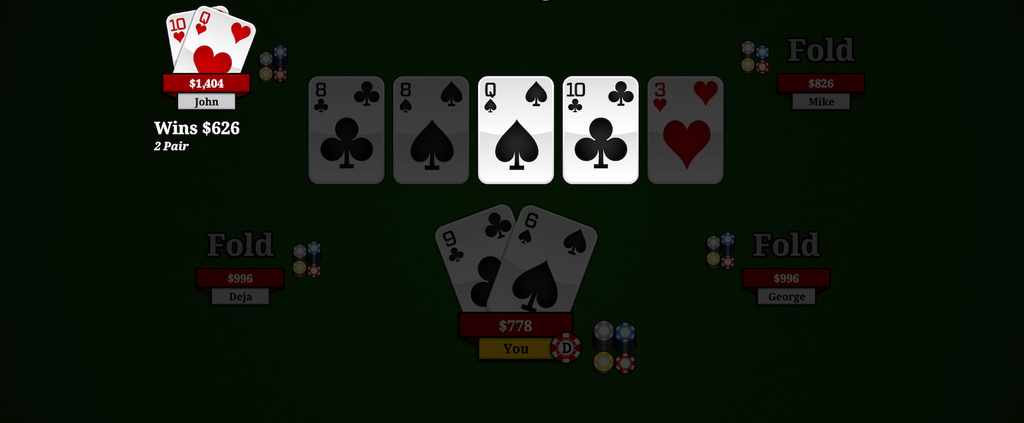
How to Determine the Winner When Poker Hands Tie
Two players can reach showdown with hands belonging to the same ranking category. In these situations, the winner is determined by comparing the relevant card values.
The most important principle is that only the best five-card hand counts. Cards outside that combination cannot be used to break a tie.
Understanding Kickers
A kicker is a card that helps distinguish otherwise equal combinations.
Consider these two five-card hands:
- Player A: K♠ K♦ A♣ 9♥ 4♠
- Player B: K♥ K♣ Q♦ J♠ 8♥
Both players have a pair of kings. However, Player A wins because the ace kicker outranks Player B’s queen.
For two-pair hands, the kicker matters only after both pairs have been compared. With four of a kind, the fifth card can also determine the winner if the quads are identical.
When Does a Split Pot Happen?
A split pot occurs when two or more players have equally ranked best five-card hands.
Imagine a Texas Hold’em board showing A♠ K♠ Q♠ J♠ 10♠. Every remaining player has the same royal flush, regardless of their hole cards. The pot is divided equally among the eligible players, subject to any side-pot arrangements.
Suits cannot resolve a tie in traditional high-hand poker. Two otherwise identical flushes in different suits have the same rank.
Poker Hand Rankings in Texas Hold’em and Omaha
Although Texas Hold’em and Omaha use the same standard hierarchy, their rules for constructing a hand differ significantly.
In Texas Hold’em, each player receives two private cards and can use any combination of their hole cards and the five community cards to create the best five-card hand. A player may use both private cards, one private card, or none.
Omaha requires players to use exactly two of their four private cards and exactly three community cards.
For example, holding a single heart in Omaha does not allow a player to make a flush using four hearts from the board. Two suited cards must come from the player’s own hand.
This distinction is especially important for beginners switching between poker variants.
How Poker Hand Rankings Influence Betting Decisions
Knowing the hierarchy helps players identify their current hand, but successful decision-making also requires evaluating how that hand compares with possible opposing combinations.
A pair of aces might appear powerful before the flop. However, on a board containing four cards of the same suit, opponents may be able to complete a flush.
Likewise, two pair on a coordinated board can become vulnerable to straights, three of a kind, or stronger two-pair combinations.
Players should consider three practical factors:
- Board texture: Connected and suited community cards create opportunities for straights and flushes.
- Opponent ranges: The hands an opponent could reasonably hold matter more than the theoretical strength of one isolated combination.
- Pot odds: Comparing the cost of calling with the potential reward helps assess whether continuing is mathematically reasonable.
Understanding these factors does not guarantee a win. Poker involves incomplete information, uncertainty, and variance, even when decisions are carefully calculated.
Common Mistakes When Comparing Poker Hands
Beginners frequently make errors that can change how they interpret an entire round.
- One common mistake is assuming a straight defeats a flush. In standard poker, a flush always ranks above a straight.
- Another is counting six or seven cards as a single combination. Even when more cards are available, the final hand must consist of exactly five.
- Players also sometimes misunderstand the ace’s position. It can complete both A-K-Q-J-10 and A-2-3-4-5, but cannot connect sequences such as K-A-2-3-4.
- Finally, some players assume that holding the highest-ranked card guarantees victory. An ace-high hand still loses to every valid pair, regardless of the other kickers.
Recognising these mistakes early can make interpreting showdowns and evaluating developing hands considerably easier.
Frequently Asked Questions About Poker Hands
What Is the Best Hand in Poker?
The royal flush is the best possible hand in traditional high-hand poker. It consists of A-K-Q-J-10 of one suit and defeats every other combination. In standard games without wild cards, no hand ranks above it.
Does a Flush Beat a Straight?
Yes. A flush ranks higher than a straight in conventional poker. A flush consists of five cards of the same suit, while a straight contains five consecutive values. The flush wins regardless of how high the opposing straight is.
Does Three of a Kind Beat Two Pair?
Yes. Three matching cards always outrank two separate pairs. For example, three twos defeat two pairs consisting of aces and kings. The hand category takes priority over the individual card values.
Can an Ace Be Low in Poker?
Yes. An ace can act as the lowest card when completing A-2-3-4-5, known as the wheel. In ordinary high-hand poker, this is a five-high straight. In other situations, the ace is the highest-ranking individual card.
What Happens When Two Players Have the Same Pair?
The highest kicker determines the winner. If both players have the same pair and highest kicker, their next kickers are compared in descending order. When all five relevant card values match, the players split the eligible pot.
Is a Full House Better Than a Flush?
Yes. A full house always defeats a flush under conventional poker rankings. The full house contains three cards of one rank and two cards of another, while a flush consists of five cards sharing the same suit.
Are Poker Hand Rankings the Same in Every Game?
No. Texas Hold’em, Omaha, and conventional Five-Card Draw generally use the standard high-hand hierarchy. However, lowball variants, high-low split formats, wild-card games, and certain video poker variations can apply different rules or payout structures.
What Is the Weakest Poker Hand?
High card is the lowest category in standard poker. The weakest possible five-card high-card combination is 7-5-4-3-2, provided it does not form a flush. It contains no pair or other qualifying combination.